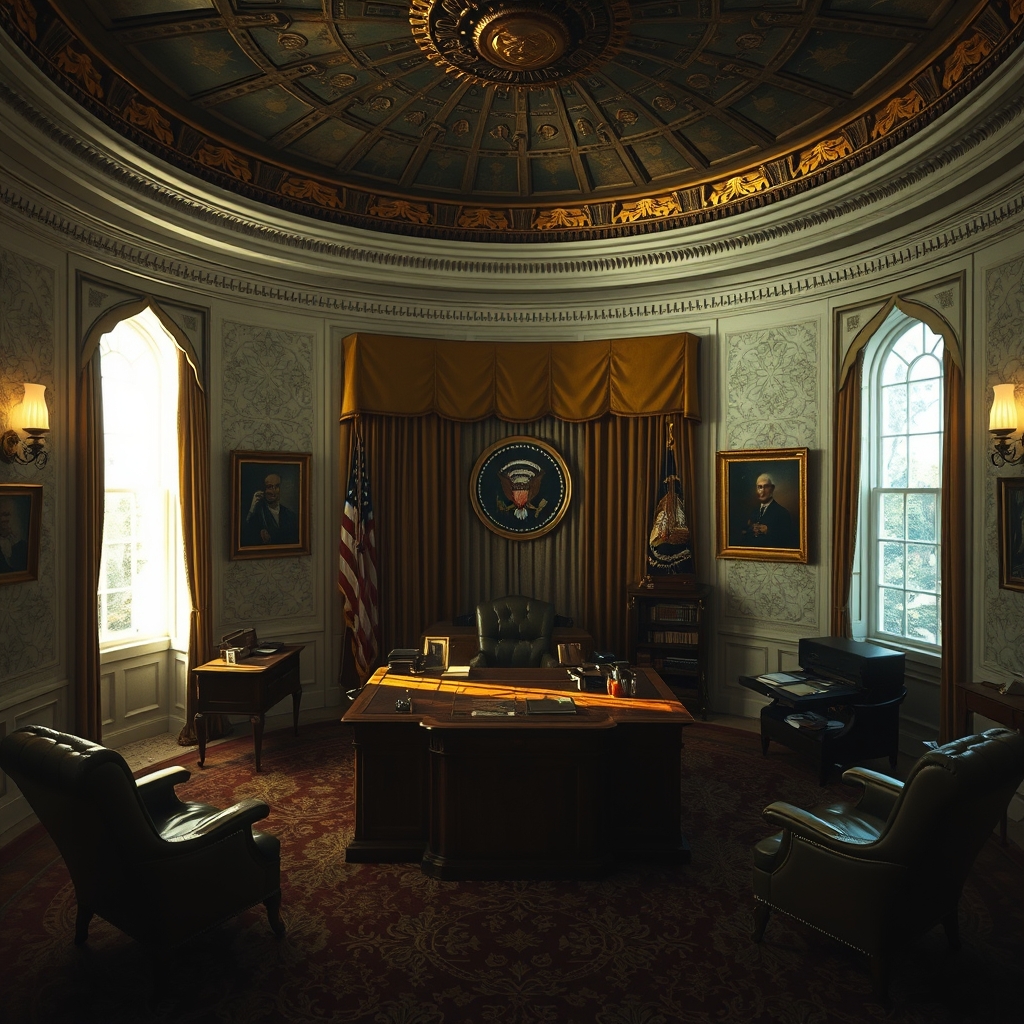
Our Institutions Crumble: Trump’s Obsession with Oval Office Props Signals Deeper Rot
Forget about soaring economies and global leadership; the most alarming news out of Washington isn’t about trade wars or foreign entanglements, but about the gilded cages of power. President Trump’s recent executive action to “preserve” the Oval Office and Cabinet Room as protected spaces, ostensibly to prevent future administrations from altering his “vision,” is more than just a petty act of vanity. It’s a glaring symptom of the systemic rot infecting our nation, a chilling testament to a leader more concerned with his personal legacy than the actual governance of a republic. For the average American, this isn’t just a bizarre anecdote; it’s another brick pulled from the foundation of our democracy, weakening the very structures that are supposed to protect your livelihood, your security, and your future. This isn’t about interior decorating; it’s about the erosion of norms, the commodification of institutions, and a dangerous precedent that whispers of a future where power is wielded not for the public good, but for the preservation of individual egos and the perpetuation of a cult of personality.
What does this mean for you, the hardworking citizen trying to make ends meet? It means that the already fragile trust you place in your government is being further pulverized. When a president uses the tools of state to safeguard his personal aesthetic preferences within the hallowed halls of American power, it signals a profound detachment from the realities faced by everyday people. While you worry about healthcare costs, job security, and the rising price of groceries, your leaders are engaged in a bizarre turf war over furniture and draperies. This isn’t just a distraction; it’s a deliberate misdirection, a theatrical performance designed to mask the more profound systemic failures. It suggests a political culture where loyalty to a leader’s whim trumps adherence to democratic principles, where institutions are seen as personal property rather than public trusts. This obsession with physical spaces, with the tangible trappings of power, betrays a deeper bankruptcy of ideas and a frightening disregard for the intangible but vital principles that underpin a functional society. We are witnessing the commodification of governance, where the symbols of power are prioritized over the substance of policy, leaving the average American increasingly disenfranchised and adrift.
The long-term consequences of such a mindset are dire, portending an era of escalating instability and diminished American influence. This petty decree is not an isolated incident; it is part of a broader pattern of behavior that normalizes the personalization of power and erodes the institutional guardrails designed to prevent abuse. When the symbols of the presidency become the personal property of the occupant, the notion of a continuous, evolving republic is undermined. Future leaders might feel emboldened to declare their own modifications as sacrosanct, leading to a chaotic and performative presidency where the focus is perpetually on the superficial rather than the substantive. This creates an environment ripe for further division and animosity, as each administration seeks to impose its will on the very symbols of national unity. For the average American, this translates into a future where political battles are increasingly fought over symbols and personalities, diverting attention and resources from the critical challenges we face, from economic inequality to climate change. It breeds cynicism, apathy, and a dangerous sense of powerlessness, as the machinery of government appears increasingly detached from the needs and aspirations of its citizens, trapped in a perpetual cycle of symbolic warfare.
Ultimately, this executive action is a harbinger of a more profound decay. It signifies a nation that is losing its grip on the very ideals it purports to champion. The obsession with preserving a president’s personal touch on the Oval Office is a morbid fascination with the ephemeral, a desperate attempt to imbue transient power with lasting significance. It distracts from the urgent need to address systemic issues that threaten our economic stability and social cohesion. As our institutions are hollowed out by such self-serving gestures, the average American will find themselves bearing the brunt of the ensuing chaos. The erosion of norms, the politicization of symbols, and the prioritization of personal branding over public service are not mere political squabbles; they are the creeping symptoms of a nation losing its way, a republic slowly succumbing to the corrosive effects of unchecked ego and a profound misunderstanding of what it truly means to lead. The real danger lies not in the color of the drapes, but in the unraveling of the fabric of our democracy itself, a process that will leave ordinary Americans more vulnerable than ever to the whims of those who hold power.
Frequently Asked Questions
What does “protected spaces” mean for the Oval Office?
It means a future president might be legally restricted from changing the decor or furnishings that the previous president established. This sets a concerning precedent of personalizing national institutions.
How does this impact the average American’s daily life?
While seemingly minor, it reflects a deeper disregard for democratic norms and institutional integrity. This can erode public trust and lead to political instability, impacting economic well-being and national security.
Is this a normal presidential action?
No, it is highly unusual and has raised concerns among governance experts. It suggests a focus on symbolic gestures over substantive policy, which can be detrimental to effective governance.

Based on reporting from: www.politico.com

Marcus Hale is a geopolitical risk analyst and investigative journalist with over a decade of experience covering economic instability, foreign policy, and systemic risk. A former consultant to financial institutions and government think tanks, Marcus has spent his career stress-testing optimistic narratives and finding the structural cracks underneath. He founded TheWorstView.today because he believes that the most patriotic thing an American can do is refuse to be comforted by convenient lies.
Drowning in despair?
It’s not all hellfire and brimstone. See the naively optimistic (but much happier) version of this story on The Best View.
Check the Bright Side →